
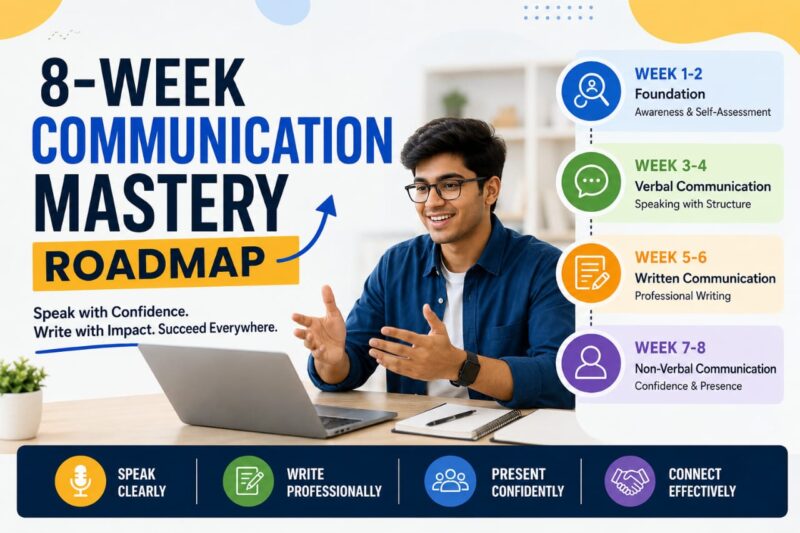
You can transform your communication skills in 8 weeks with consistent practice. Here’s the exact roadmap:
Week 1-2: Foundation — Awareness & Self-Assessment
Goal: Understand your current communication level honestly.
Daily Practice (15 minutes):
- Record yourself speaking for 2 minutes on any topic
- Watch the recording immediately
- Note 3 things you did well
- Note 3 things to improve (filler words, pace, clarity, etc.)
Weekly Milestone:
- By day 7: You’ll notice your filler words pattern
- By day 14: You’ll naturally slow down when you catch yourself rushing
Self-Assessment Questions:
- Do people ask you to repeat yourself often?
- Do you ramble instead of getting to the point?
- Are you comfortable speaking in front of groups?
- Do you prepare before important conversations?
Week 3-4: Verbal Communication — Speaking with Structure
Goal: Develop clear, structured speaking patterns.
The 3-Point Answer Structure (Use This in Every Answer):
Example:
- Q: Tell me about a challenge you faced
- Point 1: “I faced a challenge with time management in my 3rd semester when I had a major project due alongside exams”
- Point 2: “I resolved this by breaking the project into milestones and studying for 1 hour before sleep instead of cramming”
- Point 3: “This taught me that small consistent actions beat last-minute effort”
Daily Practice:
- Prepare 3-point answers for common questions
- Practice with friends in “interview” format
- Record and review
Weekly Milestone:
- By week 3: You can answer any question in a structured way
- By week 4: Your answers feel natural, not robotic
Week 5-6: Written Communication — Professional Writing
Goal: Write emails and documents that get responses and create good impressions.
Templates:
Example:
Resume Bullet Point Formula:
[Action Verb] + [What you did] + [Technology/Method] + [Result/Impact]
Examples:
- ✅ GOOD: “Built a real-time chat application using Node.js and Socket.io, achieving 50ms message latency”
- ❌ BAD: “Made a chat application that works”
Daily Practice:
- Write 2 professional emails (even if you don’t send them)
- Update your resume with better bullet points
- Rewrite one social media post professionally
Weekly Milestone:
- By week 5: Your emails sound professional without being stiff
- By week 6: Your resume speaks to recruiter requirements, not just your activities
Week 7-8: Non-Verbal Communication — Confidence & Presence
Goal: Command a room with your presence, not just words.
Body Language Checklist for Interviews:
Before You Enter:
- Shoulders back, chin up (power pose for 2 minutes)
- Firm but not tight handshake (3-second hold)
- Genuine smile (practiced in mirror)
While You Sit:
- Feet flat on floor or crossed at ankles (shows discipline)
- Back straight, slight forward lean (shows interest)
- Hands visible on table (never lap, shows honesty)
- Maintain 60-70% eye contact (direct, not staring)
- Nod occasionally (shows you’re engaged)
While You Speak:
- Use natural hand gestures (emphasizes points)
- Vary your tone (not monotone)
- Speak at moderate pace (not rushed, not slow)
- Pause for emphasis (not awkward silence)
- mile when appropriate (not all the time)
When They Speak:
- Listen fully without preparing your answer
- Show engagement through facial expressions
- Paraphrase to confirm understanding
- Ask clarifying questions if needed
Daily Practice:
- Practice interviews in front of a mirror
- Record mock interviews and watch
- Practice power poses before stressful situations
- Practice handshakes and introductions with friends
Weekly Milestone:
- By week 7: You feel more confident in your own skin
- By week 8: People comment that you seem more assured and approachable
The Communication Skills Checklist — Assess Yourself Weekly
Rate yourself on a scale of 1-5 (1=needs improvement, 5=excellent) every Monday:
| Communication Area | Week 1 | Week 3 | Week 5 | Week 7 |
| Speaking pace and clarity | — | — | — | — |
| Using filler words (lower is better) | — | — | — | — |
| Structuring answers clearly | — | — | — | — |
| Email professionalism | — | — | — | — |
| Listening actively | — | — | — | — |
| Eye contact during conversation | — | — | — | — |
| Body language confidence | — | — | — | — |
| Explaining technical concepts | — | — | — | — |
Goal: Score 4 or 5 in all areas by week 8.
FAQ: Communication & Placements
Q1: I’m an introvert. Can I still develop communication skills?
A: Absolutely. Communication skills aren’t about being extroverted. They’re about clarity and structure. Many successful introverts are excellent communicators because they listen actively and think before speaking. Introversion is actually an advantage — you naturally pause to think, which comes across as thoughtful.
Q2: How much time should I dedicate to communication practice daily?
A: Start with 20 minutes daily in weeks 1-4. This includes 10 minutes of recording yourself and 10 minutes of review. By weeks 5-8, you can reduce to 10 minutes of focused practice as it becomes second nature.
Q3: Should I practice in English only?
A: Practice in English since interviews are in English. But don’t ignore your regional language — it shows cultural awareness. Some companies in manufacturing/core sectors conduct interviews in both.
Q4: Can I improve communication in less than 8 weeks?
A: Yes, but it depends on your starting point. If you’re at 40% proficiency, you can reach 70% in 4 weeks with intense practice. The last 20% (from 70% to 90%) takes time.
Q5: How do I overcome nervousness during actual interviews?
A: Nervousness is inevitable but manageable. Do a power pose for 2 minutes before the interview (proven to boost confidence). Take 3 deep breaths before answering any question. Remember: the interviewer isn’t your enemy; they want you to succeed so they can hire you.
Q6: What if I make a mistake while speaking in an interview?
A: Most people don’t even notice. If you do: acknowledge lightly (“Sorry, let me rephrase that”), correct it, and move on. Don’t apologize excessively or draw more attention to it.
Q7: How do I practice if I don’t have friends to do mock interviews with?
A: Use these resources:
- com (free mock interviews with peers)
- io (practice with real interviewers)
- Record yourself and watch back
- Talk to your college T&P cell
Conclusion: Communication Is Learnable (Not Innate)
The biggest myth about communication is that you’re either born with it or you’re not.
False.
Communication is a skill like any other — coding, math, design. You develop it through deliberate practice.
The students who master communication aren’t naturally gifted speakers. They’re students who recorded themselves, reviewed, adjusted, and practiced. Again and again.
These are the students who walked away with offers.
The good news? You don’t need to be perfect. You need to be consistent.
Your 8-Week Challenge:
- Week 1-2: Record yourself speaking daily
- Week 3-4: Practice structured answers
- Week 5-6: Write professional communication daily
- Week 7-8: Build confident body language
By week 8, your communication will be noticeably better. By month 3, your entire placement approach will shift.
Call-to-Action Section
Ready to Transform Your Placement Prospects?
Get the FREE Communication Skills Checklist Use this weekly tracker to measure your progress across all 8 communication dimensions. Used by students who got placed.
OR
Questions? Contact your T&P Coordinator or email: tpo@infinitycollege.in
